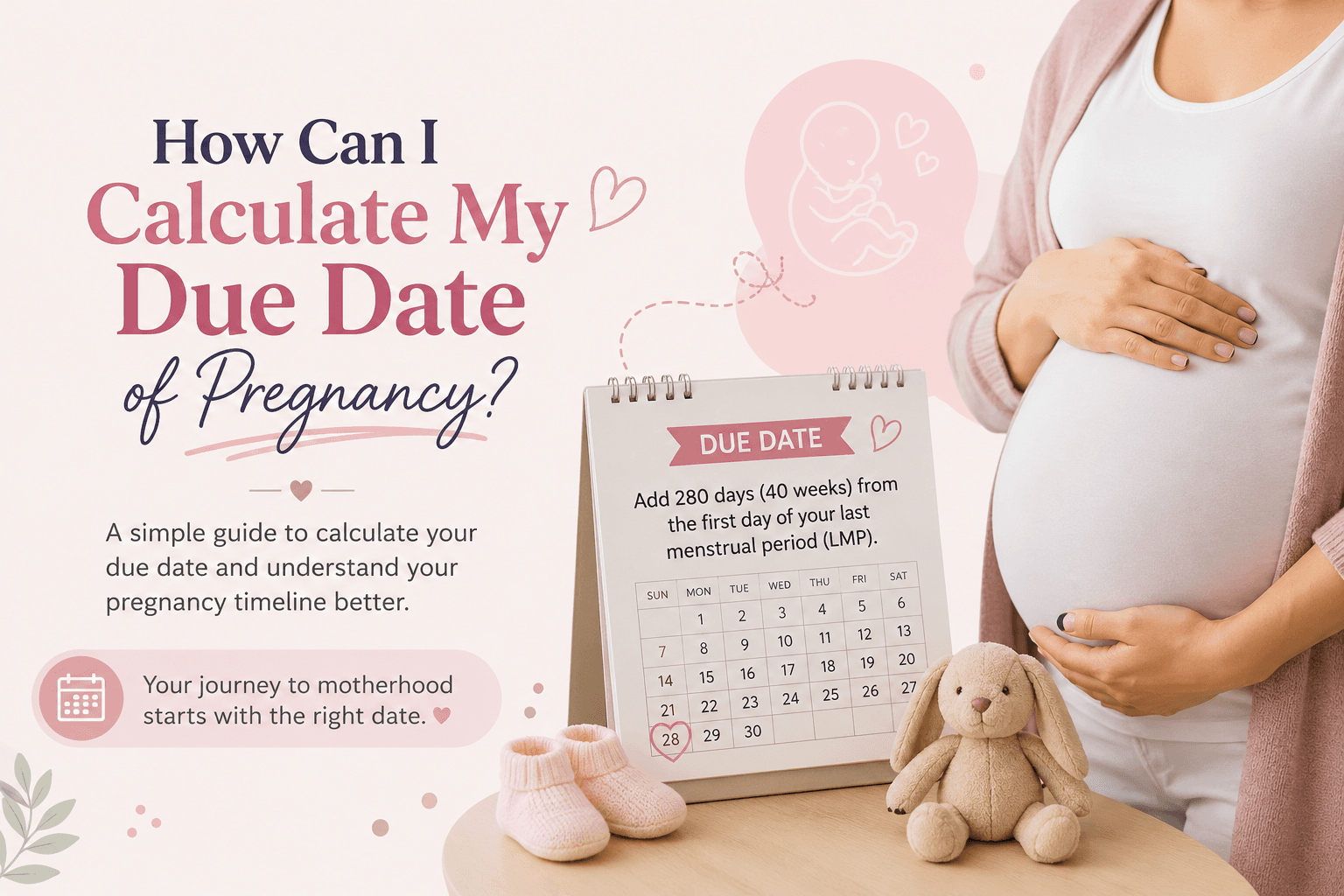
How can I calculate my due date of pregnancy is a major concern among most women. Usually, the baby comes out at 37 to 42 weeks.
Wondering when your baby is due, but don't know how to calculate the due date? There are simple methods to use through LMP, conception date, and ultrasound methods, with expert tips and examples.
How can I calculate my due date of pregnancy? It is a genuine question every woman has during childbirth. When you know the due date, you can track the development of your baby and schedule appointments accordingly. The good news is that there are various reliable and effective ways to calculate the due date that healthcare professionals suggest.
The most commonly used method is knowing the first day of your last menstrual period (LMP) to calculate the due date. Similarly, if you remember your ovulation or conception date, it will be beneficial in getting a more accurate due date. Likewise, a first-trimester ultrasound scan is another common method for analyzing the due date, and it's the most accurate of all.
How Can I Calculate My Due Date of Pregnancy?
The estimated delivery date (EDD) is when your baby is likely to be born and can be measured through various methods. According to the UK National Health Service (NHS), most babies are born within the range of 37 to 42 weeks. Moreover, about 5% of babies are born on their exact due date; generally the babies are born a few weeks before or after.
Here are a few methods to calculate your due date step by step:
Method 1: Naegele's Rule (Most Common)
You can calculate the due date of pregnancy using the formula of Naegele's Rule. It's quite easy, and women generally use it for their calculations in pregnancy.
Formula 1:
- LMP (insert your last menstrual period) + 280 days (40 weeks)
For example, if my LMP was 23 July, 2025. Then, I will have to add 280 days to my LMP.
23 July + 280 days = 29 April 2026
A few related milestones:
- 12 weeks: 15 October 2025
- 20 weeks (anomaly scan period): 10 December 2025
- 37 weeks (early term): 8 April 2026
- 40 weeks (due date): 29 April 2026
According to the Association for the improvement in the Maternity Services (AIMS), EDD is measured to 40 weeks (280 days), for the first day of your last menstrual period (LMP). It's not the exact timeline for EDD, as the child's birth varies according to the woman's physiology and environment.
Formula 2 (Easier Version):
The second formula of Naegele's Rule has three steps:
- First, add 7 days to your LMP
- Second, subtract 3 months from it
- Third, add a year
For Example:
- LMP = 10 March 2025
- Add 7 days → 17 March
- Subtract 3 months → 17 December 2024
- Add 1 year → 17 December 2025 (EDD)
Method 2: (Cycle-Based Adjustment)
Another common method used by most pregnant women to measure their due date is through cycle-based adjustment. As you know, female reproductive cycles vary from one person to another. Henceforth, if your cycle is either shorter or longer than 28 days, your EDD will vary as well.
If your cycle is NOT 28 days:
- A short cycle means that the ovulation starts earlier. Therefore, your due date will be earlier as well.
- Likewise, a long cycle suggests that the ovulation has started later. In turn, your due date is expected later than the normal timeline as well.
However, doctors usually adjust the cycle length by 28 days.
Method 3: (Conception-based)
Method 3 is suitable for those women who know their conception date. It's easier to calculate; you just need to add 266 days to your conception date.
Conception date + 266 days (38 weeks)
For Example:
My conception date is 6 August, 2025. Now, I just have to add 266 days to it.
6 August + 266 days = 29 April, 2026 (my estimated due date)
For women who have a longer menstrual cycle, you are most likely to have a 35-day cycle. In such a case, you need to follow this example:
- LMP: 23 July, 2025
- Ovulation: approximately 13 August, 2025
- Conception: approximately 13 August, 2025
- Adding 266 days:
- Due date: 6 May, 2026
As you can notice, this due date is one week later than the standard LMP-based estimate that we have done earlier. It happens because the ovulation has occurred later.
Method 4: Ultrasound Dating (Most Accurate Method)
Ultrasound Dating is a scientific method that is based on ultrasound scanning results. During the first-trimester scan (typically 10–13 weeks), women usually have an ultrasound, in which sonographers measure the baby's Crown-Rump Length (CRL).
The CRL shows the current baby size, and it is compared with established growth charts for the baby. This method helps to estimate the gestational age of the baby. A 12-week ultrasound scan also helps in:
- Used by the National Health Service (NHS) to confirm gestational age
- Can adjust the due date if the baby's size differs
Additionally, you can use a tool and pair it with your ultrasound to get exact due date. When I was learning about how can I calculate my due date during pregnancy, I used various tools to check which one followed the standard medical guidelines. The best tool that helped me calculate the due date accurately was Panakit Due Date.
I just added my LMP date and it calculated my due date to 38 weeks. To verify the due date, I also used the manual tools and the results were the same. It only took a minute to calculate my due date through Panakit, it both saved my effort and time. Its result gave me an approximation and later I adjusted my due date with ultrasound findings.
| Scenario | Based on LMP | 12-Week Ultrasound Finding | Interpretation | Adjusted Due Date |
Example 1: Due Date Stays the Same | LMP: 23 July 2025 EDD: 29 April 2026 | Baby measures exactly 12 weeks | Fetal growth matches the expected gestational age. No evidence of earlier or later ovulation. | 29 April 2026 (No change) |
Example 2: Due Date Moves Earlier | LMP: 23 July 2025 EDD: 29 April 2026 | Baby measures 12 weeks 5 days instead of 12 weeks | The baby is measuring about 5 days ahead. It suggests that conception/ovulation has most likely occurred earlier than estimated. | Approximately 24 April 2026 |
Example 3: Due Date Moves Later | LMP: 23 July 2025 EDD: 29 April 2026 | Baby measures 11 weeks 2 days instead of 12 weeks | The baby is measuring about 5 days behind in this case. It asserts that conception/ovulation has occurred later than estimated. | Approximately 4 – 5 May 2026 |
Expert Medical Understanding Every Woman Should Know about Pregnancy
When you are wondering how to calculate your due date of pregnancy, you must have this expert medical understanding:
- Pregnancy is dated from LMP, not conception.
- This standardization helps hospitals globally.
- Ultrasound is used to refine, not replace, early dating. The due date is an estimation of the child's birth. Therefore, the actual delivery can vary depending on biological variations.
- Doctors often use LMP first, even if ovulation is later.
- Apps often calculate the due date through a perfect 28-day cycle, while the real bodies differ, and the due dates aren't exact.
Conclusion
How can I calculate my due date of pregnancy is a major concern among most women. Usually, the baby comes out at 37 to 42 weeks, depending on the bearer's physiology. There are various proven and widely used methods to measure the due date, calculated from LMP, conception, and cycle-based methods. According to NHS standards, it usually takes about 40 weeks from LMP to reach the due date.
Frequently Asked Questions (FAQs)
Which methods are best for calculating the Due Date for pregnancy?
There are various methods and tools for calculating the due date during pregnancy; however, the most authentic and best practices are the following:
- Ultrasound Dating
- Naegele's Rule
- Cycle-based adjustment
- Conception-based method
Why are the due dates not exact during pregnancy?
Pregnancy length varies according to ovulation and conception dates (cycle differences), and through genetics, affecting the gestation length. Moreover, first pregnancies are generally longer than later ones.
How can I calculate my due date of pregnancy through a formula?
A simple way to calculate your due date is through the formula:
LMP + 280 days equals the due date
What is the practical advice for pregnant women for calculating the due date?
- Track LMP carefully
- Don’t rely only on apps
- Confirm at 12-week scan
- Prepare for a flexible window, not a fixed date
- Focus on health milestones, not exact delivery day
For more info visit Panakit.com