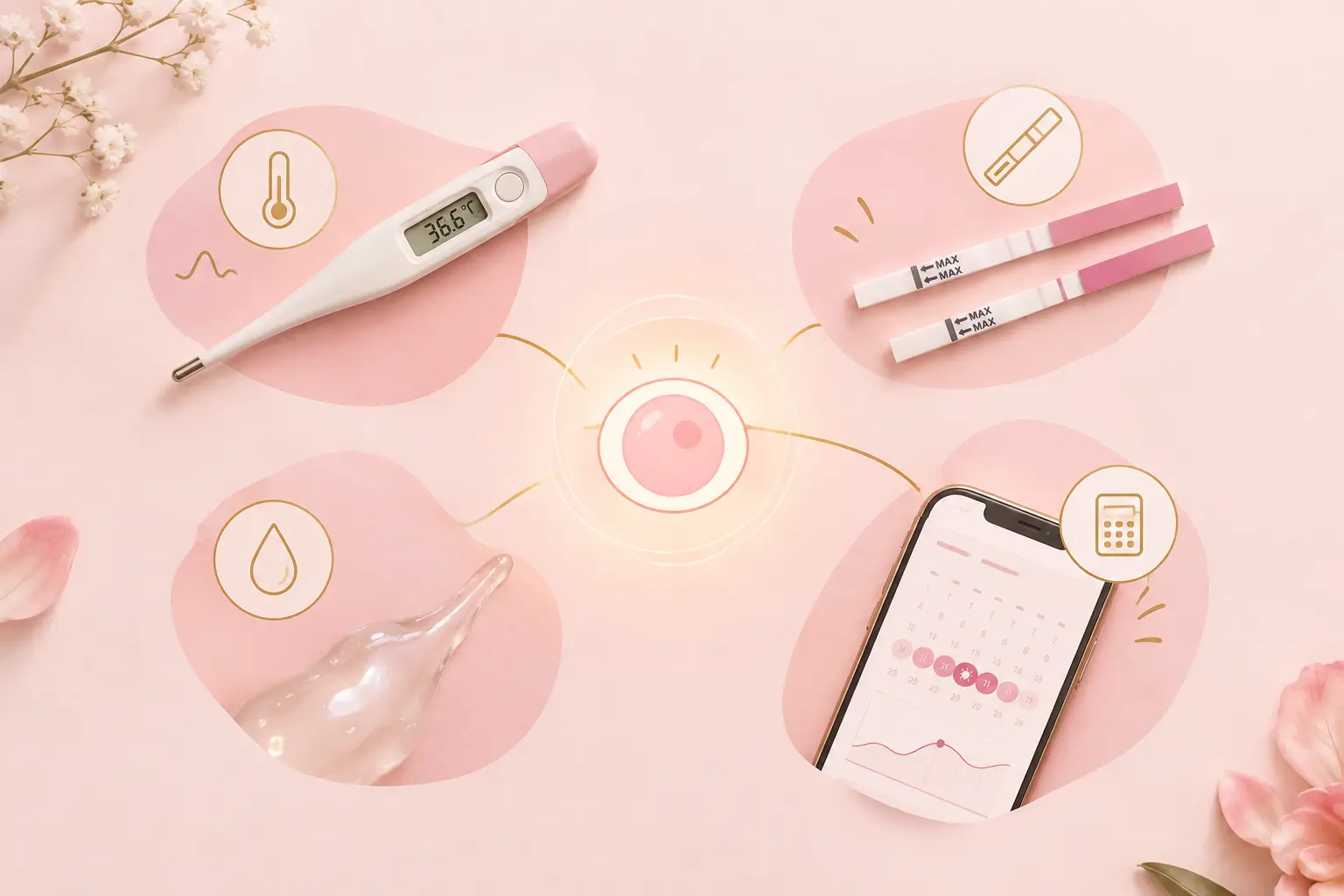
Best Way to Track Ovulation: BBT vs OPK vs Cervical Mucus vs Calculator
The most reliable way to track ovulation is combining an ovulation predictor kit (OPK) with basal body temperature (BBT), not choosing one over the other. That's because they don't measure the same thing: an OPK predicts ovulation is coming, before it happens, while BBT confirms ovulation already happened, after the fact. If you've ever compared the two and found they don't quite line up, that's not a sign something's wrong with either method, it's because they're answering different questions at different times.
Why Ovulation Tracking Methods Often Disagree With Each Other
This is the actual source of most of the confusion people run into. An OPK detects the LH surge that triggers ovulation, which typically happens 24 to 36 hours before the egg is actually released. BBT, on the other hand, only rises after ovulation has occurred, often a day or more later. So if your OPK peaked on Tuesday and your temperature didn't rise until Thursday or Friday, that's expected, not a contradiction. The two methods are describing two different points on the same timeline, not competing estimates of the same moment.
Cervical mucus and calendar-based calculators add two more data points to that same timeline, mucus changes signal an approaching fertile window before ovulation, similar in timing to an OPK, while a calculator estimates a likely day in advance based on your average cycle, useful for planning ahead but not built to react to what's actually happening in real time.
Ovulation Predictor Kits (OPK): What They Actually Tell You
OPKs detect the surge in luteinizing hormone (LH) in your urine that triggers ovulation, typically 24 to 36 hours before it happens. This makes them a predictive tool, useful for timing intercourse in advance, not just confirming what already occurred.
The limitation worth knowing: a positive OPK confirms an LH surge happened, not that ovulation definitely followed it. Especially with irregular cycles or conditions like PCOS, it's possible to get a hormone surge without actual ovulation occurring afterward. An OPK alone can't tell you the difference.
Basal Body Temperature (BBT): What It Actually Tells You
BBT rises slightly, usually 0.5 to 1 degree Fahrenheit, after ovulation occurs, and stays elevated for the rest of your cycle. According to Mayo Clinic, you're actually most fertile in the two to three days before that temperature rise, which means by the time BBT confirms ovulation happened, your most fertile window for that cycle has typically already passed. This is exactly why BBT works well for confirmation and cycle pattern tracking, but poorly on its own for timing intercourse in the moment.
BBT is also genuinely sensitive to outside factors: poor sleep, illness, alcohol, and even the time you took your temperature can shift a reading enough to make a chart look inconsistent from day to day. A single odd temperature reading usually isn't meaningful on its own, look at the overall pattern across several days instead. This is worth knowing if you are postpartum and breastfeeding, since broken sleep from night feeds is one of the most common reasons BBT charts look noisy in those first several months.
Cervical Mucus: What It Actually Tells You
In the days leading up to ovulation, cervical mucus typically becomes clearer, wetter, and more stretchy, often compared to raw egg white. This shift can be a useful, free, real-time signal that your fertile window is approaching, similar in timing to an OPK.
The tradeoff is consistency: mucus changes can be more subjective to interpret than a test strip or a number on a thermometer, and some people find it harder to read clearly cycle to cycle, especially early on before they've learned their own patterns.
Calendar and Calculator Methods: What They Actually Tell You
A calculator estimates your likely ovulation day based on your average cycle length and a typical luteal phase, useful for knowing roughly when to start paying closer attention, well before you'd see any physical signs. This is the right tool for planning ahead, deciding when to start testing with an OPK, or getting a general sense of your fertile window using the ovulation calculator or fertile window calculator.
What it can't do is confirm anything in real time, since it's working from your past average, not what's actually happening in your body this cycle. It's a starting point for the other three methods, not a replacement for them. If you're not sure what day that puts you on, ovulation day by cycle length breaks it down for every common cycle length from 21 to 35 days.
If your cycle length itself isn't established yet, for example if you have recently stopped hormonal birth control, a calculator has little to work from until you've tracked a real cycle or two, which makes the direct methods above more useful in the meantime.
The Best Approach: Combining Methods
Based on how each method actually works, this is the practical combination that avoids the confusion most people run into:
Use a calculator to get a rough idea of when your fertile window is likely to start, so you know when to begin paying attention. Start using OPKs a few days before that estimated window to catch your LH surge and predict ovulation 24 to 36 hours in advance, timing intercourse around that surge. Track BBT throughout your cycle to confirm, after the fact, that ovulation actually happened and to build a longer-term picture of your typical pattern. Use cervical mucus changes as a free, supporting signal alongside the others, not as your only method.
No single method alone gives you the full picture. Together, they cover prediction, real-time signals, and confirmation. Once you've identified your fertile window this way, how often you actually need to have sex during it matters more than covering every single day of it.
What to Do If Your Methods Don't Match
A BBT rise landing one to three days after your OPK peak is completely normal, not a sign of a problem, since that's the expected gap between the LH surge and the temperature shift that follows ovulation. If your temperature stays flat for longer than that after a clear OPK peak, or doesn't rise at all, it's worth tracking a few more cycles before drawing conclusions, since illness, poor sleep, or inconsistent temperature-taking can all delay or blur the pattern on any single cycle. If this happens consistently across several cycles, that's worth raising with a healthcare provider rather than continuing to troubleshoot alone.
Frequently Asked Questions
Should I use OPK or BBT if I can only pick one?
If you are actively trying to conceive and need to time intercourse in advance, OPK is generally more actionable, since it predicts before ovulation happens rather than confirming afterward. BBT is more useful if your main goal is understanding your overall cycle pattern over time.
Why did my OPK show positive but my BBT never rose?
This can happen when there's an LH surge without ovulation actually following it, sometimes called an anovulatory cycle. It's more common with irregular cycles or conditions like PCOS. If this happens repeatedly, it's worth discussing with a healthcare provider.
How many days after my OPK peak should I expect my temperature to rise?
Typically one to three days, since ovulation itself follows the LH surge by 24 to 36 hours, and the temperature rise follows ovulation by roughly a day. A gap outside that range on an occasional cycle usually isn't cause for concern on its own.
Can a calculator alone be enough to track ovulation?
For a general sense of timing, especially with a regular cycle, a calculator is a reasonable starting point. For anyone actively trying to conceive or wanting to confirm ovulation actually happened, pairing it with a direct method like OPK or BBT gives a much clearer picture than calendar estimates alone.
Basal body temperature timing and fertility window information per Mayo Clinic.
Medical disclaimer. This article is for general educational purposes and is not a substitute for medical advice. Consult a healthcare provider for guidance specific to your situation.